
The problem
A wedding is personal. Planning one is operationally complex. Couples have to coordinate vendors, hundreds of guests, multi-currency spending, dependent tasks, contracts, seating constraints, and a day that must run to the minute. Much of that work still lives across spreadsheets, messaging threads, inboxes, and notes.
Altar began with a product question:
Could the entire wedding operation live in one place that both partners can run together, with AI helping at the moments where it is genuinely useful?
The result is an installable, bilingual PWA that follows the journey from the first budget decision to live day-of coordination.
More than a dashboard
The dashboard does not stop at a countdown. It reads readiness across tasks, vendors, RSVPs, budget, and contracts, then surfaces the strongest area and the part that needs attention. Guidance changes with the wedding stage, so the product can say what matters six months out rather than showing the same generic checklist every day.
Zero-signup guest demo
  → countdown and readiness score
  → vendors and contracts
  → guests, budget, and tasks
  → seating and critical path
  → invitations, gallery, and music
  → live day-of mode
This breadth required one shared wedding context rather than a collection of isolated tools. A vendor payment affects the budget. An RSVP changes the seating plan. A delayed task can move the critical path.
A concierge that can act
The Azure OpenAI GPT-4o Concierge is connected to product data and actions. Couples can ask questions in natural language, and the assistant can prepare a task, guest, or vendor record. Its approval mode keeps the user in control before anything changes. Responses stream token by token through the Vercel AI SDK.
User intent
  → streaming response
  → Azure OpenAI GPT-4o
  → proposed action and user approval
  → Server Action
  → PostgreSQL / Prisma
  → updated wedding context
AI also appears where a chat window would be the wrong interface. Azure Document Intelligence extracts uploaded contracts before GPT-4o identifies risk and negotiation points. Focused tools draft vendor emails, wedding speeches, and invitation copy. Vision Studio analyses venue and inspiration images.
Spatial planning with real constraints
Seating is not a names-in-a-table problem. The dnd-kit editor places tables and seats on a visual canvas, supports automatic assignment, checks capacity and conflicts, and exports the finished layout to PDF.
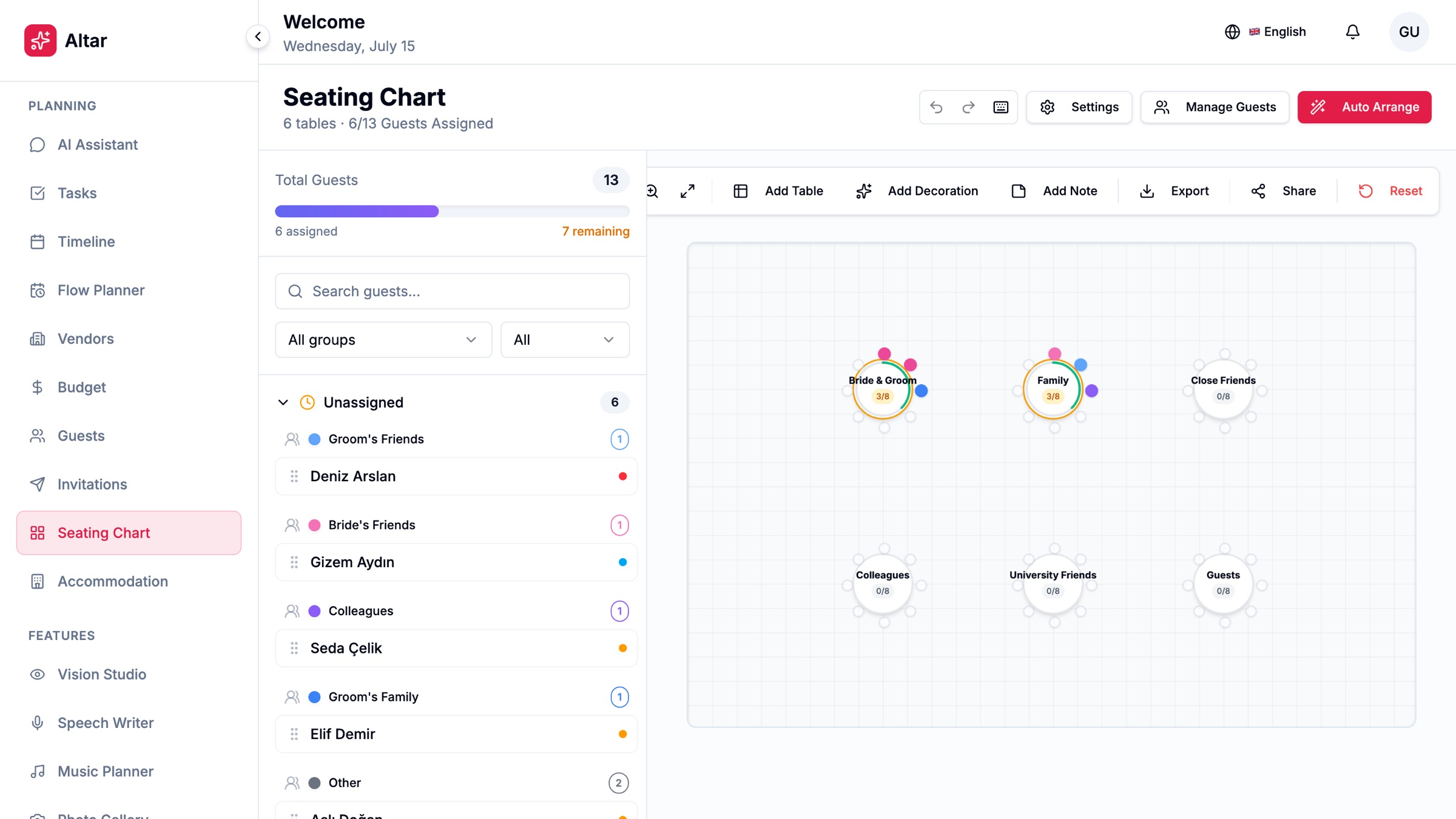
The same operational thinking runs through the timeline and Flow Planner. Task dependencies reveal the critical path; the day-of view brings the live schedule, QR check-in, vendor arrivals, and emergency contacts into one run of show.
Treating money as a decision system
The budget workspace separates spent, committed, and remaining money instead of collapsing everything into one total. Live exchange rates support multiple currencies, while category breakdowns and Recharts visualisations make the shape of the plan easy to read.
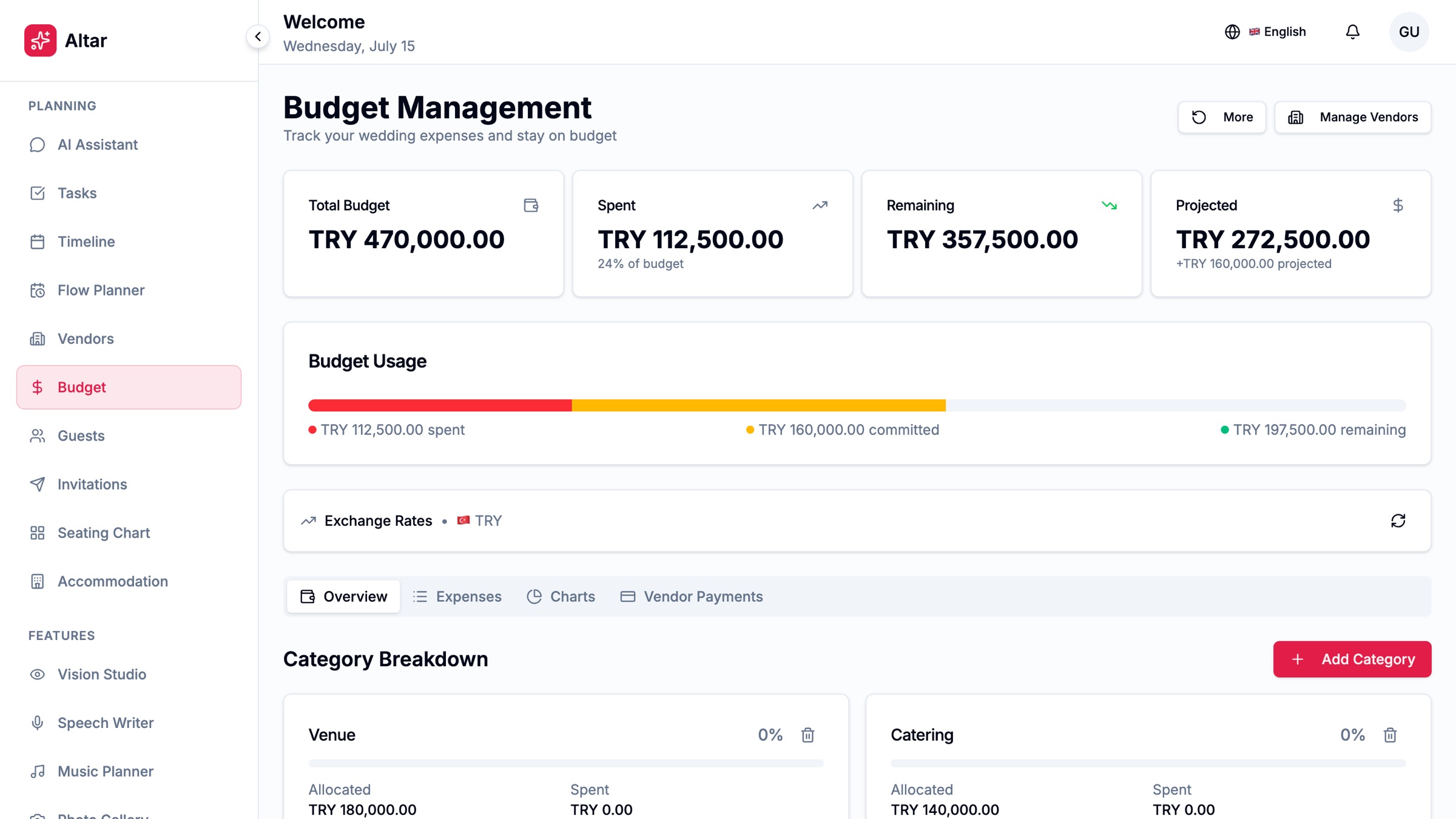
In the demo scenario, TRY 112,500 of a TRY 470,000 plan has been spent. That concrete state shows more than a feature list: it shows how Altar helps a couple understand what has happened and what they can still change.
A useful demo without registration
The live product does not ask visitors to fill in a registration form before they can understand it. Explore as guest creates an isolated demo account and a populated wedding—with vendors, guests, tasks, and budget records—in one transaction. Stale demos are removed after 24 hours.
This makes the product's strongest workflows repeatable without exposing a shared test account or dropping visitors into empty states.
Bilingual and mobile by design
Altar has more than 900 translation keys per locale across 26 product sections. Dates and money follow the active locale, and Turkish and English cover the product, AI interactions, and transactional messages rather than the navigation alone.
Desktop tables become cards on smaller screens. Filters move into bottom sheets. Dense forms switch between dialogs and drawers. Forty-four-pixel touch targets and bottom-tab navigation make the product practical while standing in a venue, not just while sitting at a desk.
Azure architecture and production discipline
The Next.js 15 and React 19 application runs as a standalone container on Azure Container Apps. PostgreSQL Flexible Server, Azure Blob Storage, and Document Intelligence hold the stateful responsibilities, while Azure Container Registry supplies the application image.
Managed Identity provides keyless access to Azure services. Storage is reached through a cross-region Private Endpoint. A service worker with a dynamic BUILD_VERSION, paired with no-cache headers, prevents an installed PWA from staying on a stale release after deployment.
The quality layer includes strict TypeScript, Zod validation, Vitest unit tests, and Playwright end-to-end coverage. The application spans 34 Prisma models and roughly 150 Server Action functions.
What it proves
Altar treats generative AI as part of a long-running, emotionally demanding workflow—not as a separate showcase. Planning, communication, money, document review, and live event operations share one product context.
The live demo proves product breadth and technical integration. It does not claim adoption at scale or product-market fit that has not been measured.
My role
I designed and built the product concept, user experience, visual system, full-stack application, data model, AI workflows, Azure architecture, security boundaries, test foundation, and production delivery as a solo project.